Published applications of PyRETIS
This collection highlights peer-reviewed applications of PyRETIS across molecular kinetics, condensed-phase chemistry, biomolecular transitions, and method development. Each study couples a physical system with a path-sampling strategy and an associated publication.
Where available, Source files lead to the inputs of the study: a
retis.rst for PyRETIS 3, and a README describing
requirements and execution. PyRETIS 4 refuses these inputs as they
stand: it lists the settings to remove, and the migration guide describes how to bring a PyRETIS 3 input
forward. The CO2 hydrate nucleation study gives a retis.toml
written for PyRETIS 4 and no retis.rst; PyRETIS 4 refuses it
as it stands too: its gromacs_input/grompp.mdp sets
tcoupl = Nose-Hoover, which a path-sampling run refuses, and no
gen-temp, and the run says what to set instead. It loads its
initial paths ([initial-path] method = "load") from a load
folder that the package does not hold. Large solvated and ab initio
systems are intended for HPC environments and require system-specific
convergence studies.
Biomolecular kinetics
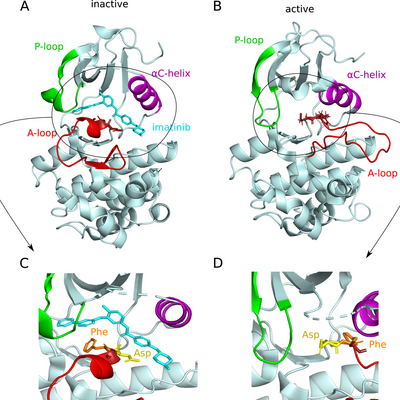
ABL-imatinib kinetics with RETIS and REPPTIS.
RETIS and REPPTIS were used to characterise the ABL-imatinib transition at atomistic resolution, assessing path-sampling performance and rare-event kinetic estimates in a large biomolecular system.
Source files Not available yet.
Publication W. Vervust, D. T. Zhang, E. Riccardi, T. S. van Erp and A. Ghysels, Path sampling challenges in large biomolecular systems: RETIS and REPPTIS for ABL-imatinib kinetics, Biophys. J. 124, 3932-3947 (2025).
Method development
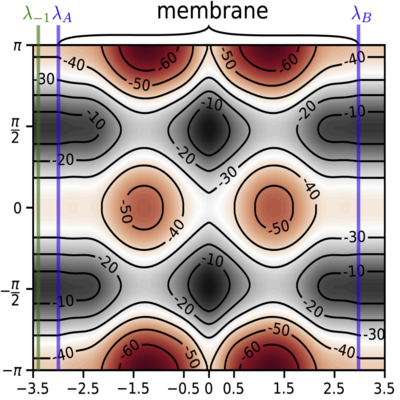
Memory reduction using partial path ensembles.
Partial path ensembles and replica exchange were examined as a route to reduce path-storage requirements when long-lived metastable states govern the reaction dynamics.
Source files Repository
Publication W. Vervust, D. T. Zhang, T. S. van Erp and A. Ghysels, Path sampling with memory reduction and replica exchange to reach long permeation timescales, Biophys. J. 122, 2960-2972 (2023).

Condensed-phase dynamics
Rupture of a thin liquid film.
Wire Fencing and Stone Skipping subtrajectory Monte Carlo moves were applied to dodecane-film rupture in water with GROMACS, providing a condensed-phase benchmark for enhanced path sampling.
Source files Download inputs
Publication D. T. Zhang, E. Riccardi and T. S. van Erp, Enhanced path sampling using subtrajectory Monte Carlo moves, J. Chem. Phys. 158, 024113 (2023).
Ab initio kinetics
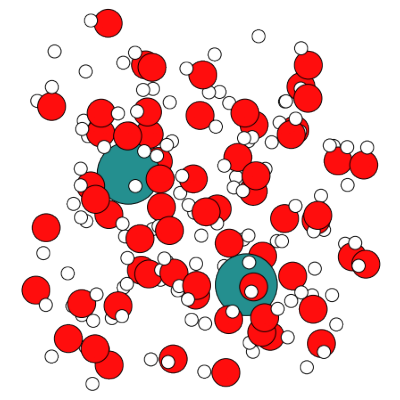
Redox reaction of a diruthenium complex.
The subtrajectory moves were evaluated for an ab initio CP2K model of a diruthenium aqua complex, where the high cost of each force evaluation makes efficient path generation essential.
Source files Download inputs
Publication D. T. Zhang, E. Riccardi and T. S. van Erp, Enhanced path sampling using subtrajectory Monte Carlo moves, J. Chem. Phys. 158, 024113 (2023).
Data-driven analysis
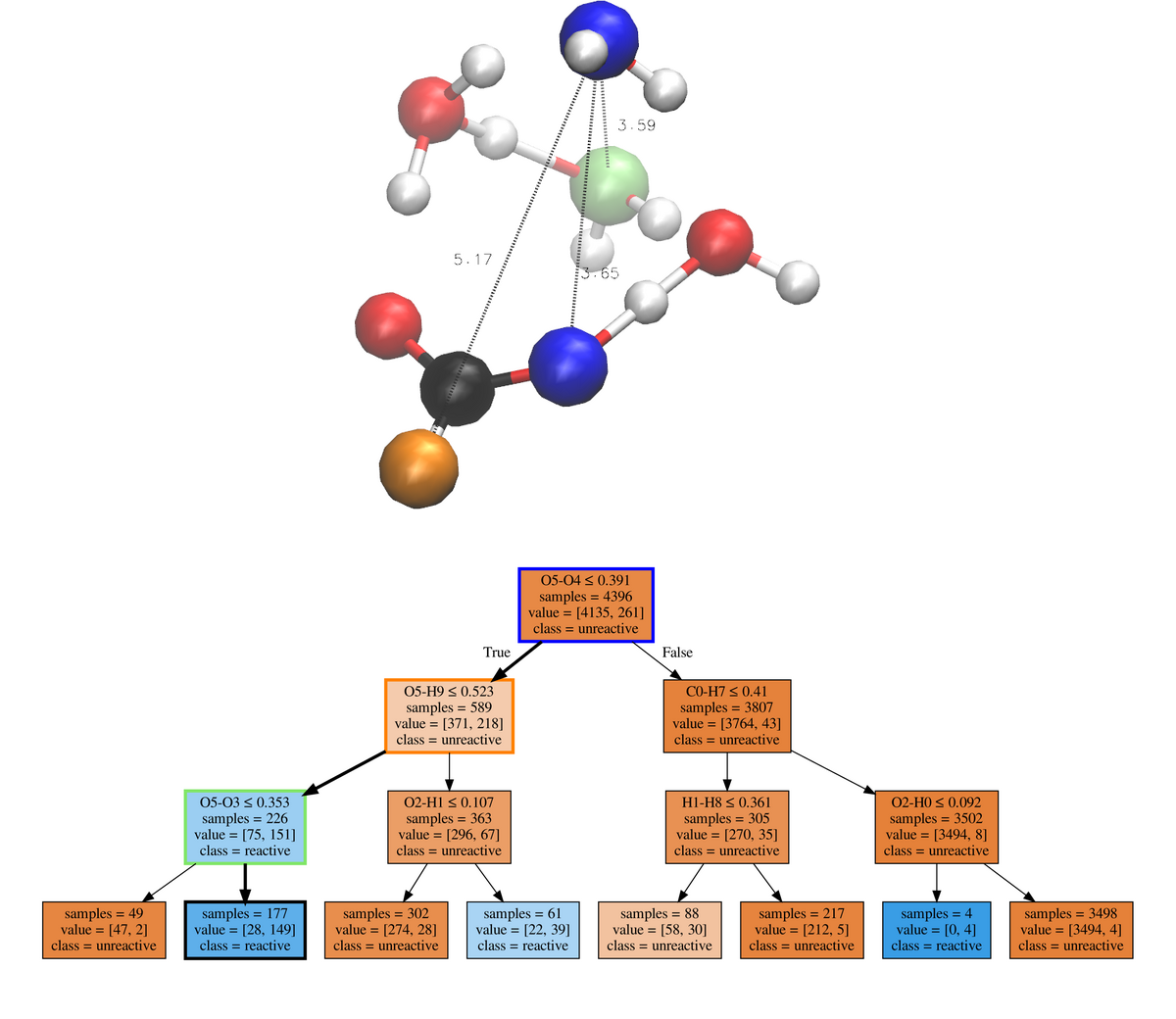
ChemiTrees for reaction-path interpretation.
Decision-tree analysis was used as a post-processing workflow for path-sampling trajectories of proton exchange in formic acid-water clusters, identifying geometric descriptors that distinguish reactive and unreactive paths.
Source files Not available yet.
Publication S. Roet, C. D. Daub and E. Riccardi, Chemistrees: data driven identification of reaction pathways via machine learning, J. Chem. Theory Comput. 17, 6193-6202 (2021).
Proton-transfer dynamics
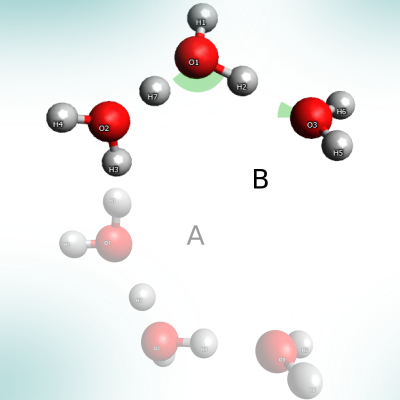
Proton transfer in a water trimer.
Proton transfer in a polarizable water trimer provides a compact reference system for examining path-sampling trajectories and the analysis and visualisation workflows in PyVisA. The various features of PyVisA can be tested on the simulation outputs.
Source files A reduced 1D model and the PyVisA data of the published run
Publication O. Aarøen, H. Kiær and E. Riccardi, PyVisA: Visualization and Analysis of path sampling trajectories, J. Comput. Chem. 42, 435-446 (2021).
Atmospheric chemistry
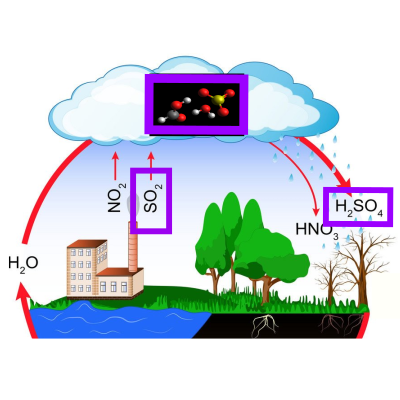
Formic acid catalysed formation of sulfuric acid.
The formic-acid-catalysed conversion of sulfur trioxide and water to sulfuric acid was investigated to resolve competing mechanisms and determine their temperature-dependent rate constants.
Source files Download inputs
Publication C. D. Daub, E. Riccardi, V. Hänninen and L. Halonen, Path sampling for atmospheric reactions: formic acid catalysed conversion of SO3 + H2O to H2SO4, PeerJ Phys. Chem. 2, e7 (2020).
Biomolecular recognition
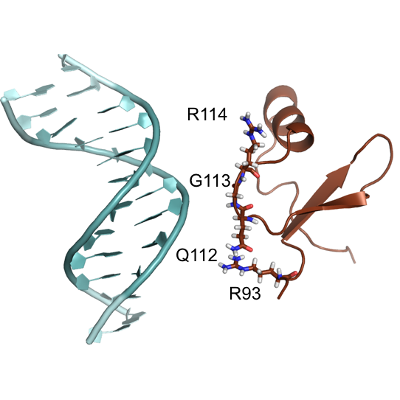
Predicting the mechanism and rate of H-NS binding to AT-rich DNA.
H-NS adsorption to AT-rich DNA was studied at atomistic resolution with GROMACS. Metadynamics identified metastable basins, and RETIS was used to calculate transition pathways and kinetic rates.
Source files Download inputs
Publication E. Riccardi, E. C. van Mastbergen, W. W. Navarre and J. Vreede, Predicting the mechanism and rate of H-NS binding to AT-rich DNA, PLoS Comput. Biol. 15, e1006845 (2019).
Aqueous reaction dynamics
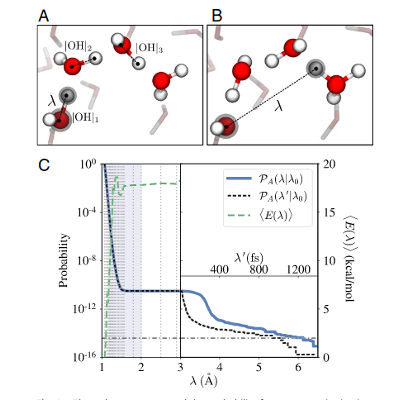
Autoionization of water.
Born–Oppenheimer DFT simulations combined with RETIS were used to resolve water autoionization pathways and quantify their kinetics. Machine-learning analysis assessed the discriminatory power of the candidate order parameters.
Source files Download inputs
Publication M. Moqadam, A. Lervik, E. Riccardi, V. Venkatraman, B. K. Alsberg and T. S. van Erp, Local initiation conditions for water autoionization, Proc. Natl. Acad. Sci. U.S.A. 115, E4569-E4576 (2018).
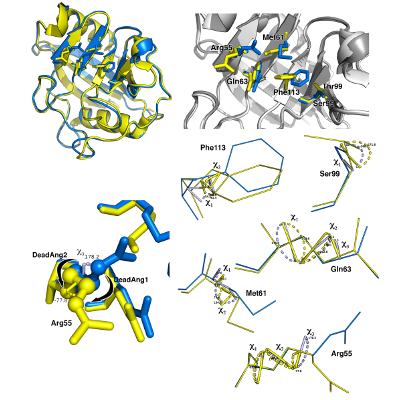
Protein conformational dynamics
Conformational study of Cyclophilin - A.
Atomistic GROMACS simulations were used to sample structural rearrangements of cyclophilin A and estimate their transition rates.
Source files Download inputs
Publication Manuscript in preparation.
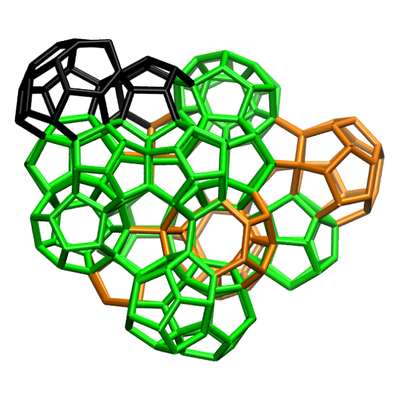
Nucleation
CO2 Hydrate Nucleation.
Atomistic GROMACS simulations were used to sample the mechanisms and rate of CO2 gas hydrate nucleation.
Source files Download inputs
Publication Manuscript in preparation.